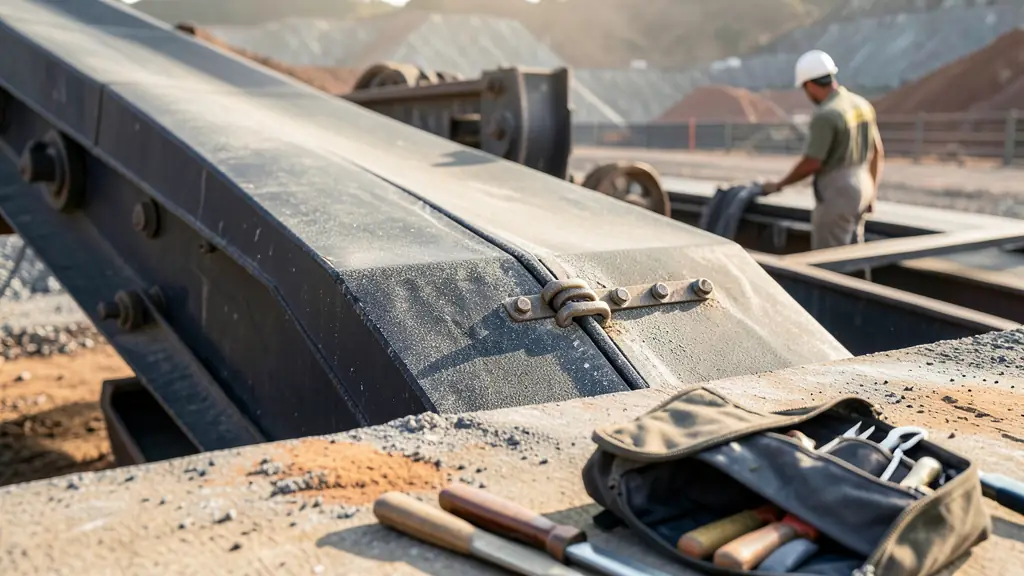
Conveyor belt fasteners join the two ends of a belt without a vulcanising press. A row of steel teeth is driven or bolted into each end and linked by a hinge pin. They suit light and medium belts, temporary repairs and sites where a hot splice is not practical. ConveyorBelting.co.za is a free quote-request service, not a supplier. Tell us the belt width, thickness and duty, and we pass your request to independent suppliers of conveyor belt clips and clamps, who quote you directly with no obligation.
Types of conveyor belt fasteners
Mechanical splices fall into a few common groups:
- Plate fasteners: steel plates bolted or riveted through the belt, used on thicker rubber belts
- Hinged clips: staples or teeth driven into the carcass and joined with a pin, common on light textile belts
- Solid-plate and heavy-duty clamps: for abrasive, high-tension runs where a cold or hot splice is not possible
Pin material matters too. Stainless, galvanised and plain steel pins suit different environments, from wet washdown to dry stockpiles.
Choosing the right belt lacing
Belt lacing must match the belt, not just the width. Check the belt thickness, ply rating and cover grade, the working tension, the smallest pulley diameter and the material carried. Fasteners should be rated for the belt tension, and pulleys must be large enough for the splice to bend without cracking the teeth. Use the maker's table for the mechanical splices you are considering and leave a margin for peak loads. Sharp or sticky material can catch on a raised fastener, so a cleaner or scraper may need a clearance check.
Fasteners compared with vulcanised splices
A mechanical joint is quick, needs no heat or curing time, and can be made by a trained fitter on site. The trade-off is strength and life. A fastener splice usually carries less tension than a hot vulcanised splice and can wear belt cleaners and pulley lagging. It also leaves a gap that can leak fines. Many sites use fasteners for emergencies and temporary repairs, then replace them with a vulcanised joint at the next planned stop. Steel-cord belts are almost always vulcanised.
Fitting and inspection
A good fastener splice starts with a square cut and a belt end free of damaged plies. Use the correct tools, set the fasteners to the right depth and keep the joint straight and square to the belt edge. Lock out the conveyor before any work. Inspect the pin, teeth and belt edge regularly, as a loose pin or a pulled tooth can fail suddenly. Keep a record of when the splice was made.
Comparing conveyor belt fasteners quotes
Prices change with rubber and steel costs, the exchange rate and stock levels. When quotes arrive, check:
- Exact specification: width, carcass and strength, cover grade and thickness, or the part number, size and standard.
- Quantity and units: per metre, per roll, per item or per set, and any minimum order or cutting charge.
- Lead time: ex stock, or imported or made to order, and how long that takes.
- Delivery and VAT: transport to site, offloading of heavy rolls, whether VAT is included and how long the price holds.
What to include in your request
- Belt width, thickness and ply or cord rating
- Working tension and smallest pulley diameter
- Material carried and operating environment
- Number of splices and whether tools are needed
- Delivery address and how soon you need them
Frequently asked questions
Are you a supplier of conveyor belt fasteners?
What belt details do I need for a quote?
Can fasteners be used on steel-cord belts?
How long does a mechanical splice last?
Conveyor Belt Fasteners by province
- Conveyor Belt Fasteners Gauteng
- Conveyor Belt Fasteners Mpumalanga
- Conveyor Belt Fasteners North West
- Conveyor Belt Fasteners Limpopo
- Conveyor Belt Fasteners Northern Cape
- Conveyor Belt Fasteners Free State
- Conveyor Belt Fasteners KwaZulu-Natal
- Conveyor Belt Fasteners Eastern Cape
- Conveyor Belt Fasteners Western Cape
Conveyor Belt Fasteners by city and town
- Conveyor Belt Fasteners in Johannesburg
- Conveyor Belt Fasteners in Pretoria
- Conveyor Belt Fasteners in Germiston
- Conveyor Belt Fasteners in Boksburg
- Conveyor Belt Fasteners in Benoni
- Conveyor Belt Fasteners in Kempton Park
- Conveyor Belt Fasteners in Springs
- Conveyor Belt Fasteners in Vanderbijlpark
- Conveyor Belt Fasteners in Vereeniging
- Conveyor Belt Fasteners in Carletonville
- Conveyor Belt Fasteners in Krugersdorp
- Conveyor Belt Fasteners in eMalahleni (Witbank)
- Conveyor Belt Fasteners in Middelburg
- Conveyor Belt Fasteners in Secunda
- Conveyor Belt Fasteners in Ermelo
- Conveyor Belt Fasteners in Kriel
- Conveyor Belt Fasteners in Mbombela (Nelspruit)
- Conveyor Belt Fasteners in Lydenburg
- Conveyor Belt Fasteners in Rustenburg
- Conveyor Belt Fasteners in Brits
- Conveyor Belt Fasteners in Klerksdorp
- Conveyor Belt Fasteners in Potchefstroom
- Conveyor Belt Fasteners in Polokwane
- Conveyor Belt Fasteners in Lephalale
- Conveyor Belt Fasteners in Burgersfort
- Conveyor Belt Fasteners in Phalaborwa
- Conveyor Belt Fasteners in Mokopane
- Conveyor Belt Fasteners in Kimberley
- Conveyor Belt Fasteners in Kathu
- Conveyor Belt Fasteners in Postmasburg
- Conveyor Belt Fasteners in Upington
- Conveyor Belt Fasteners in Springbok
- Conveyor Belt Fasteners in Bloemfontein
- Conveyor Belt Fasteners in Welkom
- Conveyor Belt Fasteners in Sasolburg
- Conveyor Belt Fasteners in Kroonstad
- Conveyor Belt Fasteners in Durban
- Conveyor Belt Fasteners in Pinetown
- Conveyor Belt Fasteners in Pietermaritzburg
- Conveyor Belt Fasteners in Richards Bay
- Conveyor Belt Fasteners in Newcastle
- Conveyor Belt Fasteners in Empangeni
- Conveyor Belt Fasteners in Gqeberha (Port Elizabeth)
- Conveyor Belt Fasteners in Kariega (Uitenhage)
- Conveyor Belt Fasteners in East London
- Conveyor Belt Fasteners in Cape Town
- Conveyor Belt Fasteners in Bellville
- Conveyor Belt Fasteners in Saldanha
- Conveyor Belt Fasteners in George
- Conveyor Belt Fasteners in Worcester