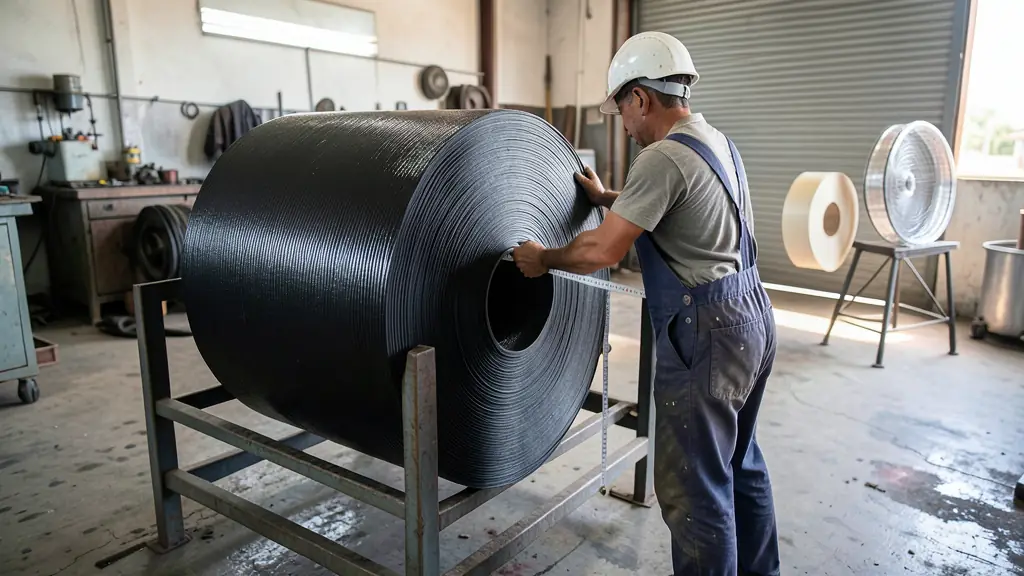
Choosing between conveyor belt types comes down to what you move, how far, how fast and how heavy. The wrong belt wears out early or stretches, and the right one runs for years. ConveyorBelting.co.za is a free quote-request service. Tell us your material, width and length, and we pass your request to independent suppliers who recommend a suitable belt and quote directly. We are not a belt supplier ourselves. This guide explains the main types, conveyor belt sizes and specifications, so your request is complete.
Main conveyor belt types
- Textile-reinforced rubber belts: EP (polyester and nylon) or NN carcass, the general-purpose choice, made to SANS 1173
- Steel-cord belts: high tension and long distance, made to SANS 1366 or ISO 15236 / DIN 22131
- Fire-resistant belts: used underground in coal, tested to SANS 971 and ISO 340
- PVC and PU belts: light duty and food-grade work
- Modular plastic belts: hygienic packing and food lines
Standard conveyor belt widths
The standard conveyor belt widths run from 450 to 2400 mm. Common South African widths are 600, 750, 900, 1050, 1200, 1350, 1500 and 1800 mm. Width depends on the capacity needed, the lump size and the pulley and idler frame already installed. A belt must also suit the existing troughing angle, usually 20, 35 or 45 degrees. Replacing a belt on an existing conveyor means matching the current width exactly. Measure the belt itself rather than trusting old drawings, as belts are sometimes replaced with a slightly different width over the years. Wider belts need larger pulleys, and troughing idlers sized for the belt, such as 102, 127, 152, 165 or 178 mm diameter rollers.
Strength, plies and cover grades
Belt strength appears as a marking such as EP630/4: a polyester-nylon carcass of 630 N/mm with four plies. Steel-cord belts use ST ratings, from ST1000 to ST5400. The conveyor belt specifications also cover cover thickness, top and bottom, and the cover grade. SANS 1173 grades M and N, DIN grades W, X, Y and Z and ISO grades H, D and L are rated on abrasion resistance, tested to ISO 4649 or DIN 53516. Sharp or heavy lump needs thicker, tougher covers. Fine, dry or sticky material needs less. Using a heavier belt than the duty requires only adds weight and cost, so a supplier should match the grade to your material.
Conveyor belt dimensions to supply
For a quote, a supplier needs the conveyor belt dimensions that matter: width, overall length in metres, number of plies or the ST rating, and cover thicknesses. Also state belt speed, incline, material type and size, and how the belt will be joined. A splice adds length, so quote the loop length or the pulley centres instead of guessing. If you are unsure, send photos of the belt edge, any printed markings and the take-up arrangement. A good supplier can often identify the type from these, and will visit the site to confirm before quoting a large order.
Comparing conveyor belt types and sizes quotes
Prices change with rubber and steel costs, the exchange rate and stock levels. When quotes arrive, check:
- Exact specification: width, carcass and strength, cover grade and thickness, or the part number, size and standard.
- Quantity and units: per metre, per roll, per item or per set, and any minimum order or cutting charge.
- Lead time: ex stock, or imported or made to order, and how long that takes.
- Delivery and VAT: transport to site, offloading of heavy rolls, whether VAT is included and how long the price holds.
What to include in your request
- Belt width in mm and total length in metres
- Material carried, lump size and abrasiveness
- Existing ply or ST rating and cover thickness, if known
- Belt speed, incline and conveyor length
- Splice type and who will fit the belt
Frequently asked questions
Are you a conveyor belt supplier?
How do I measure my existing belt?
What does a rating such as EP630/4 mean?
Which type suits long-distance conveying?
Conveyor Belt Types and Sizes by province
- Conveyor Belt Types and Sizes Gauteng
- Conveyor Belt Types and Sizes Mpumalanga
- Conveyor Belt Types and Sizes North West
- Conveyor Belt Types and Sizes Limpopo
- Conveyor Belt Types and Sizes Northern Cape
- Conveyor Belt Types and Sizes Free State
- Conveyor Belt Types and Sizes KwaZulu-Natal
- Conveyor Belt Types and Sizes Eastern Cape
- Conveyor Belt Types and Sizes Western Cape
Conveyor Belt Types and Sizes by city and town
- Conveyor Belt Types and Sizes in Johannesburg
- Conveyor Belt Types and Sizes in Pretoria
- Conveyor Belt Types and Sizes in Germiston
- Conveyor Belt Types and Sizes in Boksburg
- Conveyor Belt Types and Sizes in Benoni
- Conveyor Belt Types and Sizes in Kempton Park
- Conveyor Belt Types and Sizes in Springs
- Conveyor Belt Types and Sizes in Vanderbijlpark
- Conveyor Belt Types and Sizes in Vereeniging
- Conveyor Belt Types and Sizes in Carletonville
- Conveyor Belt Types and Sizes in Krugersdorp
- Conveyor Belt Types and Sizes in eMalahleni (Witbank)
- Conveyor Belt Types and Sizes in Middelburg
- Conveyor Belt Types and Sizes in Secunda
- Conveyor Belt Types and Sizes in Ermelo
- Conveyor Belt Types and Sizes in Kriel
- Conveyor Belt Types and Sizes in Mbombela (Nelspruit)
- Conveyor Belt Types and Sizes in Lydenburg
- Conveyor Belt Types and Sizes in Rustenburg
- Conveyor Belt Types and Sizes in Brits
- Conveyor Belt Types and Sizes in Klerksdorp
- Conveyor Belt Types and Sizes in Potchefstroom
- Conveyor Belt Types and Sizes in Polokwane
- Conveyor Belt Types and Sizes in Lephalale
- Conveyor Belt Types and Sizes in Burgersfort
- Conveyor Belt Types and Sizes in Phalaborwa
- Conveyor Belt Types and Sizes in Mokopane
- Conveyor Belt Types and Sizes in Kimberley
- Conveyor Belt Types and Sizes in Kathu
- Conveyor Belt Types and Sizes in Postmasburg
- Conveyor Belt Types and Sizes in Upington
- Conveyor Belt Types and Sizes in Springbok
- Conveyor Belt Types and Sizes in Bloemfontein
- Conveyor Belt Types and Sizes in Welkom
- Conveyor Belt Types and Sizes in Sasolburg
- Conveyor Belt Types and Sizes in Kroonstad
- Conveyor Belt Types and Sizes in Durban
- Conveyor Belt Types and Sizes in Pinetown
- Conveyor Belt Types and Sizes in Pietermaritzburg
- Conveyor Belt Types and Sizes in Richards Bay
- Conveyor Belt Types and Sizes in Newcastle
- Conveyor Belt Types and Sizes in Empangeni
- Conveyor Belt Types and Sizes in Gqeberha (Port Elizabeth)
- Conveyor Belt Types and Sizes in Kariega (Uitenhage)
- Conveyor Belt Types and Sizes in East London
- Conveyor Belt Types and Sizes in Cape Town
- Conveyor Belt Types and Sizes in Bellville
- Conveyor Belt Types and Sizes in Saldanha
- Conveyor Belt Types and Sizes in George
- Conveyor Belt Types and Sizes in Worcester