Conveyor belt manufacturers in South Africa make the rubber and fabric belts that move ore, coal, aggregate and packed goods. Some belts are made locally, others are imported and supplied by distributors. ConveyorBelting.co.za is a free quote-request service. Send your specification and we pass it to independent manufacturers and suppliers who quote directly. We do not make or sell belting. The request is free and carries no obligation to accept any quote.
How conveyor belts are made
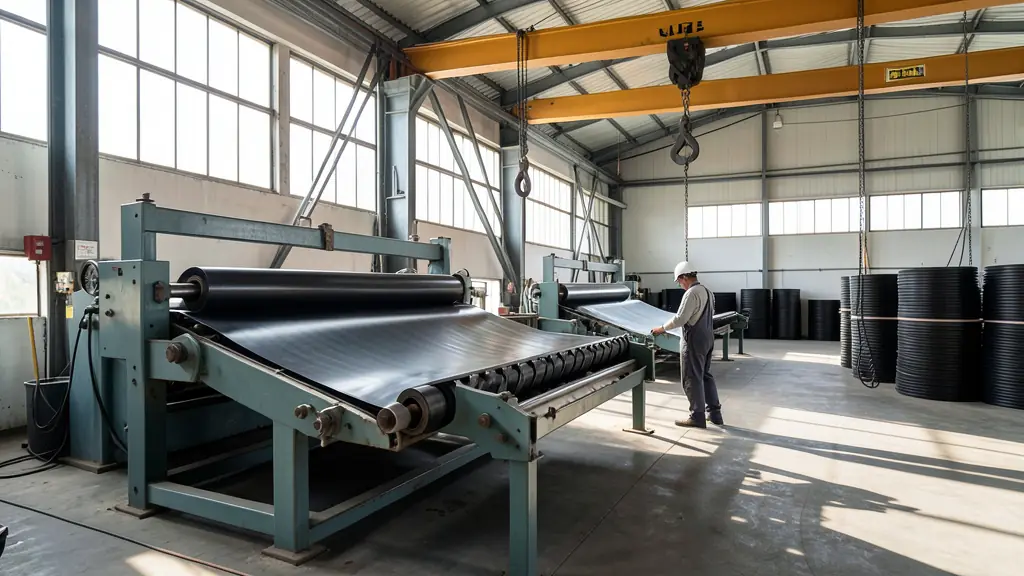
The process behind conveyor belt manufacturing is layered. Fabric plies or steel cords form the carcass. Rubber is calendered onto them, and covers are added. The belt is then cured in a vulcanising press, section by section, until the full length is complete.
- Textile: EP or NN plies, rated by number of plies and strength
- Steel cord: parallel cords in rubber, rated ST1000 to ST5400
- PVC and PU: light belts made by coating or laminating fabric
Each press cure leaves a joint line between sections, which is normal when the belt is built up in lengths. The finished belt is wound onto a reel for transport, so large steel-cord belts are often shipped in several reels and joined on site.
Standards and quality
Look for compliance with the standard that matches your duty: SANS 1173 for general textile belting, SANS 1366 and ISO 15236 for steel cord, and SANS 971 or ISO 340 for fire-resistant belts underground. Cover quality is tested for abrasion to ISO 4649 or DIN 53516. Ask for test certificates, and for a manufacturer working under an ISO 9001 quality system. For fire-resistant belting, ask whether the belt is approved for underground use by the relevant authority, since the Mine Health and Safety Act requires belts underground to meet fire-resistance standards.
Made to order or from stock
Belts for standard duties may be available from stock. Large-width, high-tension or special-property belts are normally made to order. Allow time for production, testing and shipping. Many suppliers are distributors for manufacturers, so ask who made the belt and where. Local manufacture can reduce lead time and ease repairs. Ask also about spare belt holding and whether repair kits are supplied with the order. Ask the manufacturer about technical support too, for example belt calculations, a recommendation on splice type and training for your own splicing team. These services reduce downtime far more than a small difference in belt price.
Beyond the belt
Some belt conveyor manufacturers also supply complete conveyors, frames, idlers and drives. Others make only belting. If you need a full conveyor, say so in your request. Include the duty, capacity and layout so firms can quote for the correct scope.
Comparing conveyor belt manufacturers quotes
Prices change with rubber and steel costs, the exchange rate and stock levels. When quotes arrive, check:
- Exact specification: width, carcass and strength, cover grade and thickness, or the part number, size and standard.
- Quantity and units: per metre, per roll, per item or per set, and any minimum order or cutting charge.
- Lead time: ex stock, or imported or made to order, and how long that takes.
- Delivery and VAT: transport to site, offloading of heavy rolls, whether VAT is included and how long the price holds.
What to include in your request
- Belt width, length and strength rating
- Cover grade, thickness and special properties
- Standard required and test certificates
- Quantity, delivery date and site address
- Whether you need splicing or a complete conveyor
Frequently asked questions
Are you a conveyor belt manufacturer?
Are conveyor belts made in South Africa?
How long does a made-to-order belt take?
What documents should a manufacturer provide?
Conveyor Belt Manufacturers by province
- Conveyor Belt Manufacturers Gauteng
- Conveyor Belt Manufacturers Mpumalanga
- Conveyor Belt Manufacturers North West
- Conveyor Belt Manufacturers Limpopo
- Conveyor Belt Manufacturers Northern Cape
- Conveyor Belt Manufacturers Free State
- Conveyor Belt Manufacturers KwaZulu-Natal
- Conveyor Belt Manufacturers Eastern Cape
- Conveyor Belt Manufacturers Western Cape
Conveyor Belt Manufacturers by city and town
- Conveyor Belt Manufacturers in Johannesburg
- Conveyor Belt Manufacturers in Pretoria
- Conveyor Belt Manufacturers in Germiston
- Conveyor Belt Manufacturers in Boksburg
- Conveyor Belt Manufacturers in Benoni
- Conveyor Belt Manufacturers in Kempton Park
- Conveyor Belt Manufacturers in Springs
- Conveyor Belt Manufacturers in Vanderbijlpark
- Conveyor Belt Manufacturers in Vereeniging
- Conveyor Belt Manufacturers in Carletonville
- Conveyor Belt Manufacturers in Krugersdorp
- Conveyor Belt Manufacturers in eMalahleni (Witbank)
- Conveyor Belt Manufacturers in Middelburg
- Conveyor Belt Manufacturers in Secunda
- Conveyor Belt Manufacturers in Ermelo
- Conveyor Belt Manufacturers in Kriel
- Conveyor Belt Manufacturers in Mbombela (Nelspruit)
- Conveyor Belt Manufacturers in Lydenburg
- Conveyor Belt Manufacturers in Rustenburg
- Conveyor Belt Manufacturers in Brits
- Conveyor Belt Manufacturers in Klerksdorp
- Conveyor Belt Manufacturers in Potchefstroom
- Conveyor Belt Manufacturers in Polokwane
- Conveyor Belt Manufacturers in Lephalale
- Conveyor Belt Manufacturers in Burgersfort
- Conveyor Belt Manufacturers in Phalaborwa
- Conveyor Belt Manufacturers in Mokopane
- Conveyor Belt Manufacturers in Kimberley
- Conveyor Belt Manufacturers in Kathu
- Conveyor Belt Manufacturers in Postmasburg
- Conveyor Belt Manufacturers in Upington
- Conveyor Belt Manufacturers in Springbok
- Conveyor Belt Manufacturers in Bloemfontein
- Conveyor Belt Manufacturers in Welkom
- Conveyor Belt Manufacturers in Sasolburg
- Conveyor Belt Manufacturers in Kroonstad
- Conveyor Belt Manufacturers in Durban
- Conveyor Belt Manufacturers in Pinetown
- Conveyor Belt Manufacturers in Pietermaritzburg
- Conveyor Belt Manufacturers in Richards Bay
- Conveyor Belt Manufacturers in Newcastle
- Conveyor Belt Manufacturers in Empangeni
- Conveyor Belt Manufacturers in Gqeberha (Port Elizabeth)
- Conveyor Belt Manufacturers in Kariega (Uitenhage)
- Conveyor Belt Manufacturers in East London
- Conveyor Belt Manufacturers in Cape Town
- Conveyor Belt Manufacturers in Bellville
- Conveyor Belt Manufacturers in Saldanha
- Conveyor Belt Manufacturers in George
- Conveyor Belt Manufacturers in Worcester