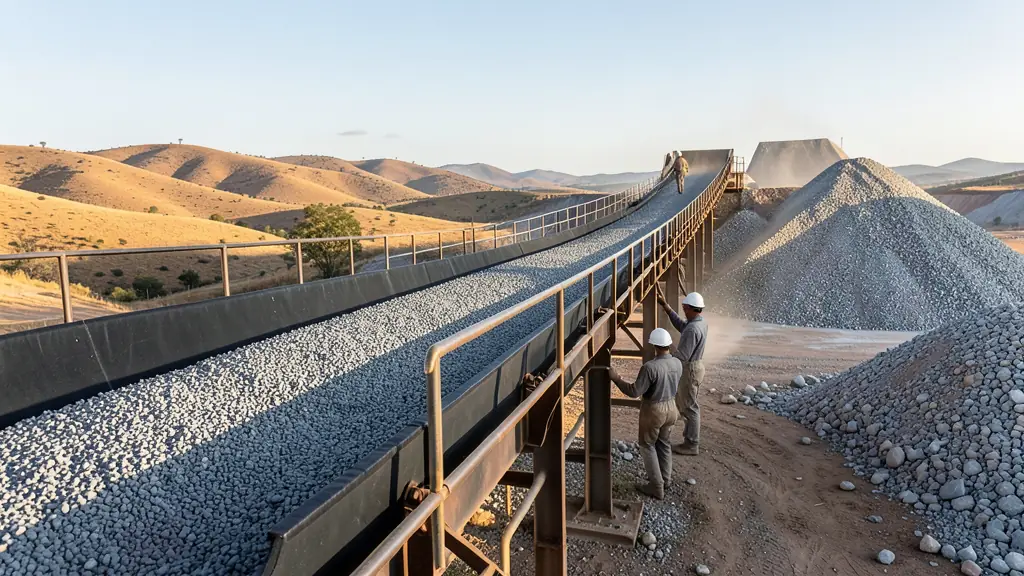
Buying conveyor belting means matching the belt to the material, the tonnage and the duty. ConveyorBelting.co.za is a free quote-request service for South Africa. Tell us what you move and where, and we pass your request to independent belting suppliers, splicing contractors and equipment suppliers who quote you directly. We do not sell belting ourselves. There is no charge and no obligation to accept a quote. Compare several offers on the same specification and choose the supplier that suits your plant.
What conveyor belt is made of
A conveyor belt has three parts: a top cover, a carcass and a bottom cover. The cover protects the carcass from abrasion, cuts, heat and oil. The carcass carries the tension.
- Textile belting: EP (polyester and nylon) or NN carcasses, rated by ply, for example EP630/4. General-purpose belts follow SANS 1173.
- Steel-cord belting: ST ratings from ST1000 to ST5400, for long and high-tension overland conveyors.
- Light belting: PVC and PU belts for packing, food and parcel handling.
Choosing the right belt
Start with the material: lump size, abrasiveness, temperature and whether it is oily or wet. Then give the belt width, length, speed, capacity and incline. Common South African widths are 600, 750, 900, 1050, 1200, 1350, 1500 and 1800 mm.
Cover grade matters. SANS 1173 grades M and N, and DIN W, X, Y and Z or ISO H, D and L, describe abrasion resistance. Tell the supplier if the belt must resist fire, heat or oil. Underground coal needs fire-resistant belting to SANS 971. Match the belt to the pulley diameter and the minimum bend radius, or the carcass will fatigue early. Ask the supplier to confirm the working tension against the belt rating, with a safety factor suited to your splice type.
Splicing, fitting and support
A belt is only as strong as its joint. Endless belts are joined by hot vulcanised splices, cold bonded splices or mechanical fasteners. Hot vulcanising gives the strongest and longest-lasting joint. Light belts often use finger splices.
Ask whether the supplier can splice on site, supply idlers, pulleys and cleaners, and offer maintenance. Good belting only performs on a well-aligned conveyor with correct tension. Belt cleaners, skirting and impact beds at the loading point protect the belt and cut spillage, so mention them if your belt wears quickly at the transfer.
What affects the quote
We do not quote prices here, because each belt is different. These factors drive cost: width, length, carcass type and ply rating, cover thickness and grade, steel cord or textile, special properties such as fire resistance, splicing, delivery and the exchange rate. Always ask for new belting to be compared on the same specification. Also give the site address, since heavy rolls need a crane or forklift to unload, and say when your next planned shutdown is. Suppliers can then plan stock, splicing crews and transport around that date, and tell you honestly if the date is not realistic.
Comparing conveyor belting quotes
Prices change with rubber and steel costs, the exchange rate and stock levels. When quotes arrive, check:
- Exact specification: width, carcass and strength, cover grade and thickness, or the part number, size and standard.
- Quantity and units: per metre, per roll, per item or per set, and any minimum order or cutting charge.
- Lead time: ex stock, or imported or made to order, and how long that takes.
- Delivery and VAT: transport to site, offloading of heavy rolls, whether VAT is included and how long the price holds.
What to include in your request
- Belt width, length and number of plies or ST rating
- Material conveyed, lump size and temperature
- Speed, capacity, incline and conveyor layout
- Cover requirements: abrasion, fire, oil or heat
- Supply only, or supply with splicing and delivery
Frequently asked questions
Are you a conveyor belting supplier?
What information do suppliers need to quote?
How do I know which cover grade I need?
Can the supplier splice the belt on site?
Conveyor Belting by province
- Conveyor Belting Gauteng
- Conveyor Belting Mpumalanga
- Conveyor Belting North West
- Conveyor Belting Limpopo
- Conveyor Belting Northern Cape
- Conveyor Belting Free State
- Conveyor Belting KwaZulu-Natal
- Conveyor Belting Eastern Cape
- Conveyor Belting Western Cape
Conveyor Belting by city and town
- Conveyor Belting in Johannesburg
- Conveyor Belting in Pretoria
- Conveyor Belting in Germiston
- Conveyor Belting in Boksburg
- Conveyor Belting in Benoni
- Conveyor Belting in Kempton Park
- Conveyor Belting in Springs
- Conveyor Belting in Vanderbijlpark
- Conveyor Belting in Vereeniging
- Conveyor Belting in Carletonville
- Conveyor Belting in Krugersdorp
- Conveyor Belting in eMalahleni (Witbank)
- Conveyor Belting in Middelburg
- Conveyor Belting in Secunda
- Conveyor Belting in Ermelo
- Conveyor Belting in Kriel
- Conveyor Belting in Mbombela (Nelspruit)
- Conveyor Belting in Lydenburg
- Conveyor Belting in Rustenburg
- Conveyor Belting in Brits
- Conveyor Belting in Klerksdorp
- Conveyor Belting in Potchefstroom
- Conveyor Belting in Polokwane
- Conveyor Belting in Lephalale
- Conveyor Belting in Burgersfort
- Conveyor Belting in Phalaborwa
- Conveyor Belting in Mokopane
- Conveyor Belting in Kimberley
- Conveyor Belting in Kathu
- Conveyor Belting in Postmasburg
- Conveyor Belting in Upington
- Conveyor Belting in Springbok
- Conveyor Belting in Bloemfontein
- Conveyor Belting in Welkom
- Conveyor Belting in Sasolburg
- Conveyor Belting in Kroonstad
- Conveyor Belting in Durban
- Conveyor Belting in Pinetown
- Conveyor Belting in Pietermaritzburg
- Conveyor Belting in Richards Bay
- Conveyor Belting in Newcastle
- Conveyor Belting in Empangeni
- Conveyor Belting in Gqeberha (Port Elizabeth)
- Conveyor Belting in Kariega (Uitenhage)
- Conveyor Belting in East London
- Conveyor Belting in Cape Town
- Conveyor Belting in Bellville
- Conveyor Belting in Saldanha
- Conveyor Belting in George
- Conveyor Belting in Worcester
Related products and services
- BL-02Conveyor Belt SuppliersRubber, PVC and PU belting, textile and steel cord
- BL-10Conveyor Belt Types and SizesTextile EP/NN belts to SANS 1173, steel-cord to SANS 1366
- SV-01Conveyor Belt SplicingHot vulcanised splices for textile and steel-cord belts
- CP-01Conveyor RollersShell diameters 89, 102, 127, 152 and 178 mm