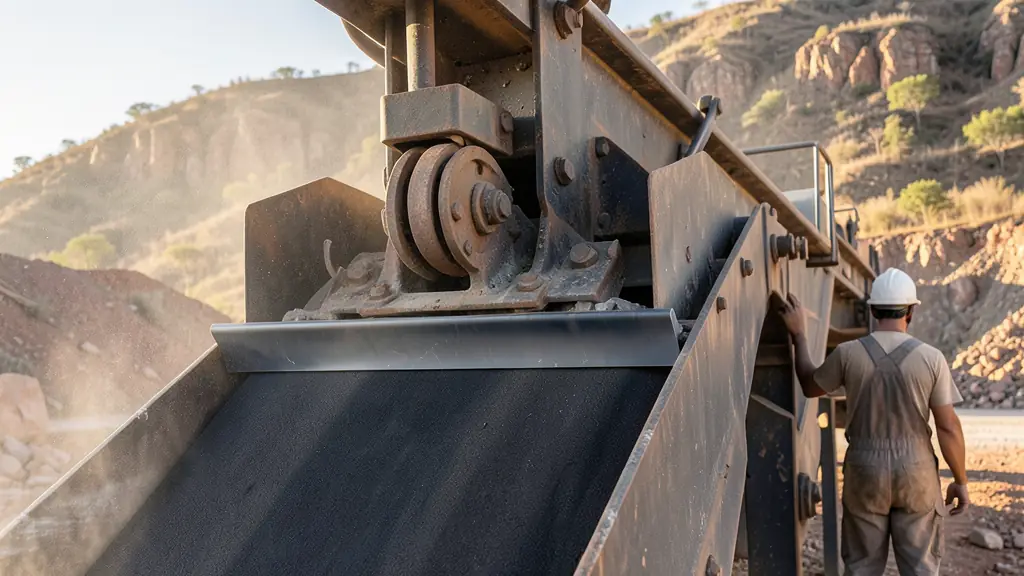
Material that sticks to the return belt falls off along the conveyor, builds up on rollers and causes mistracking. A well-chosen conveyor belt scraper removes it at the head pulley. ConveyorBelting.co.za is a free quote-request service. Tell us the belt width, material and conditions, and independent suppliers quote you directly. We do not sell scrapers ourselves, and there is no charge or obligation. Compare options for a conveyor belt cleaner, skirting or magnet in one request.
How a scraper for conveyor belt works
A scraper for conveyor belt use presses a blade against the belt surface just after the discharge pulley, so carryback drops into the chute. A good cleaner keeps the return side clean, reduces spillage and protects rollers and pulleys. Carryback is a major cause of idler failure, belt wear and clean-up labour.
Primary, secondary and other cleaners
Cleaning is usually done in stages:
- Primary cleaners: blades on the head pulley that remove the bulk of the carryback
- Secondary cleaners: further blades on the belt after the pulley, for fine material
- Plough or V-ploughs: remove debris on the return run before the tail pulley
- Brush and water-spray cleaners for sticky or food products
Blades come in polyurethane, rubber, tungsten carbide and ceramic tips. Carbide tips last longer on abrasive ore, while polyurethane suits general use and lighter belts.
Conveyor belt skirting and magnets
Conveyor belt skirting is rubber strip along the loading zone that keeps material on the belt and contains dust. Skirting wears with use, and worn skirting scores the belt cover, so check it often. A magnet for conveyor belt use, either an overband or a head pulley magnet, pulls tramp iron from the stream before it reaches a crusher or screen. Metal can rip a belt, so magnets are an important safeguard on many lines.
Choosing and fitting
Match blade material to the belt cover and the material carried, and make sure the cleaner has enough tension control to keep contact as the blade wears. Mechanical splices need extra care. Isolate and lock out before maintenance.
Cleaners need regular attention. A blade that is worn or set too tight damages the belt cover, and one set too loose leaves carryback. Check tension at every inspection, look for build-up on the blade and keep spare blades on site. Where space is limited, ask the supplier for a compact design. Mines and plants fit cleaners under the Mine Health and Safety Act and OHS guarding rules, so cleaning must never be done on a running belt.
Poor cleaning also lets fines pack under skirting and in the chute, which raises dust, wears the belt and increases clean-up labour. A modest spend on cleaners and skirting usually pays back through fewer stoppages and longer belt and roller life.
Comparing belt cleaners and scrapers quotes
Prices change with rubber and steel costs, the exchange rate and stock levels. When quotes arrive, check:
- Exact specification: width, carcass and strength, cover grade and thickness, or the part number, size and standard.
- Quantity and units: per metre, per roll, per item or per set, and any minimum order or cutting charge.
- Lead time: ex stock, or imported or made to order, and how long that takes.
- Delivery and VAT: transport to site, offloading of heavy rolls, whether VAT is included and how long the price holds.
What to include in your request
- Belt width, speed and splice type
- Material carried and whether it is wet or sticky
- Cleaner position and available space
- Skirting length or magnet requirement
- Site location and shutdown date
Frequently asked questions
Do you sell conveyor belt scrapers?
What is carryback and why does it matter?
How often should scraper blades be replaced?
Can scrapers damage mechanical splices?
Belt Cleaners and Scrapers by province
- Belt Cleaners and Scrapers Gauteng
- Belt Cleaners and Scrapers Mpumalanga
- Belt Cleaners and Scrapers North West
- Belt Cleaners and Scrapers Limpopo
- Belt Cleaners and Scrapers Northern Cape
- Belt Cleaners and Scrapers Free State
- Belt Cleaners and Scrapers KwaZulu-Natal
- Belt Cleaners and Scrapers Eastern Cape
- Belt Cleaners and Scrapers Western Cape
Belt Cleaners and Scrapers by city and town
- Belt Cleaners and Scrapers in Johannesburg
- Belt Cleaners and Scrapers in Pretoria
- Belt Cleaners and Scrapers in Germiston
- Belt Cleaners and Scrapers in Boksburg
- Belt Cleaners and Scrapers in Benoni
- Belt Cleaners and Scrapers in Kempton Park
- Belt Cleaners and Scrapers in Springs
- Belt Cleaners and Scrapers in Vanderbijlpark
- Belt Cleaners and Scrapers in Vereeniging
- Belt Cleaners and Scrapers in Carletonville
- Belt Cleaners and Scrapers in Krugersdorp
- Belt Cleaners and Scrapers in eMalahleni (Witbank)
- Belt Cleaners and Scrapers in Middelburg
- Belt Cleaners and Scrapers in Secunda
- Belt Cleaners and Scrapers in Ermelo
- Belt Cleaners and Scrapers in Kriel
- Belt Cleaners and Scrapers in Mbombela (Nelspruit)
- Belt Cleaners and Scrapers in Lydenburg
- Belt Cleaners and Scrapers in Rustenburg
- Belt Cleaners and Scrapers in Brits
- Belt Cleaners and Scrapers in Klerksdorp
- Belt Cleaners and Scrapers in Potchefstroom
- Belt Cleaners and Scrapers in Polokwane
- Belt Cleaners and Scrapers in Lephalale
- Belt Cleaners and Scrapers in Burgersfort
- Belt Cleaners and Scrapers in Phalaborwa
- Belt Cleaners and Scrapers in Mokopane
- Belt Cleaners and Scrapers in Kimberley
- Belt Cleaners and Scrapers in Kathu
- Belt Cleaners and Scrapers in Postmasburg
- Belt Cleaners and Scrapers in Upington
- Belt Cleaners and Scrapers in Springbok
- Belt Cleaners and Scrapers in Bloemfontein
- Belt Cleaners and Scrapers in Welkom
- Belt Cleaners and Scrapers in Sasolburg
- Belt Cleaners and Scrapers in Kroonstad
- Belt Cleaners and Scrapers in Durban
- Belt Cleaners and Scrapers in Pinetown
- Belt Cleaners and Scrapers in Pietermaritzburg
- Belt Cleaners and Scrapers in Richards Bay
- Belt Cleaners and Scrapers in Newcastle
- Belt Cleaners and Scrapers in Empangeni
- Belt Cleaners and Scrapers in Gqeberha (Port Elizabeth)
- Belt Cleaners and Scrapers in Kariega (Uitenhage)
- Belt Cleaners and Scrapers in East London
- Belt Cleaners and Scrapers in Cape Town
- Belt Cleaners and Scrapers in Bellville
- Belt Cleaners and Scrapers in Saldanha
- Belt Cleaners and Scrapers in George
- Belt Cleaners and Scrapers in Worcester