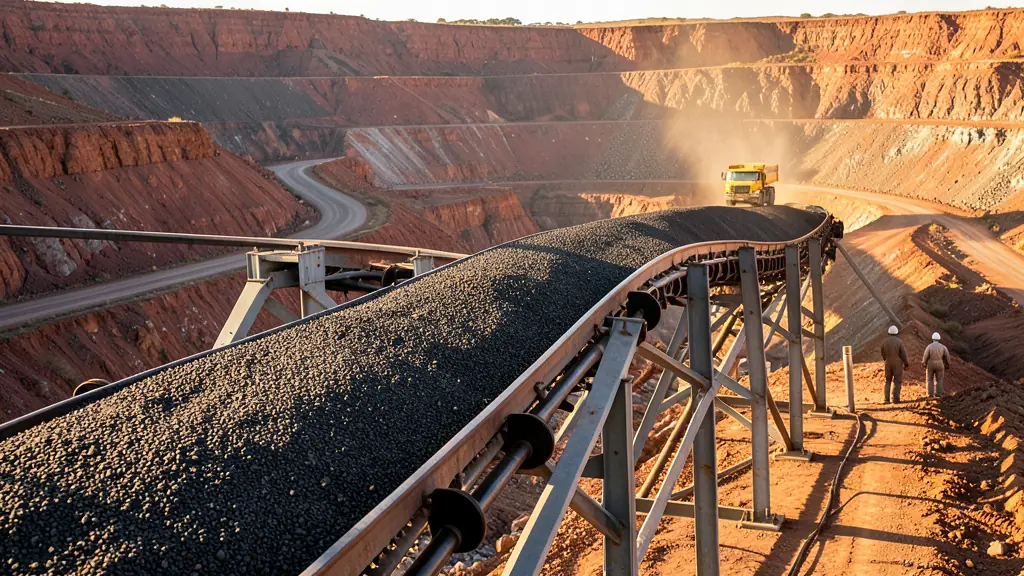
A mining conveyor belt works harder than most: heavy tonnages, sharp rock, dust, wet ground and long distances. The belt must be specified for the tension, the material and, underground, the fire rules. ConveyorBelting.co.za is a free quote-request service. Describe your conveyor belt in mining application, and we pass your request to independent belting suppliers who quote you directly. We do not sell belts ourselves, the request is free and you are under no obligation to accept any quote.
Belts for surface and underground mining
Surface mines use wide, high-capacity belts on pit, crusher, overland and stockpile lines. Underground mines use belts in drifts, on shaft bottoms and on section conveyors, where space is tight and fire is a risk. Each needs a mining conveyor belt system designed around the tonnage, lift, length and material. Cover thickness, carcass strength and edge type are chosen from those details, not from stock sizes alone. Wet, muddy or dusty conditions, steep inclines and long shift hours all push the specification up, so describe them to the supplier.
Steel cord belts
Steel cord belts carry the high tension on long, high-capacity lines. They use steel cables in the carcass, rated from ST1000 to ST5400 under ISO 15236 or DIN 22131, and in South Africa under SANS 1366. They stretch little, which helps on overland conveyors with long take-up distances. Joints are hot vulcanised by trained splicers, and cord condition is monitored with magnetic or X-ray scanning during the belt's life.
Fire-resistant underground belts
Underground coal belting must be fire-resistant and antistatic. SANS 971 covers fire-resistant textile belting for underground coal, and ISO 340 tests flame propagation. Belt use and the safety of the whole conveyor fall under the Mine Health and Safety Act and its regulations. Fire detection, pull-wire switches, belt-misalignment switches and speed switches are required on many lines. Ask the supplier for test certificates with the quote, and confirm who is responsible for fitting and for the final inspection before the belt is commissioned.
Specifying and sourcing
Give the supplier your belt width, length, lift, speed, material, lump size and tonnes per hour. Mining belts commonly run 900 to 2400 mm wide. Check the cover grade against the ore's abrasion, add impact beds at loading points, and include scrapers and skirting to protect the belt. Cost depends on width, carcass or ST rating, cover thickness, length, splicing, certification, transport and the exchange rate for imported belting. Lead times for steel cord and fire-resistant belts can be long, so request quotes early and plan the shutdown around delivery. Ask each supplier to confirm the delivery date in writing.
Comparing mining conveyor belts quotes
Prices change with rubber and steel costs, the exchange rate and stock levels. When quotes arrive, check:
- Exact specification: width, carcass and strength, cover grade and thickness, or the part number, size and standard.
- Quantity and units: per metre, per roll, per item or per set, and any minimum order or cutting charge.
- Lead time: ex stock, or imported or made to order, and how long that takes.
- Delivery and VAT: transport to site, offloading of heavy rolls, whether VAT is included and how long the price holds.
What to include in your request
- Belt width, length, lift and conveyor speed
- Material, lump size and tonnes per hour
- Surface or underground, with fire requirements
- Existing belt rating and condition
- Splicing, installation and delivery to the mine
Frequently asked questions
Are you a mining conveyor belt supplier?
When do I need a steel cord belt?
What makes a belt suitable for underground coal?
What affects mining belt cost?
Mining Conveyor Belts by province
- Mining Conveyor Belts Gauteng
- Mining Conveyor Belts Mpumalanga
- Mining Conveyor Belts North West
- Mining Conveyor Belts Limpopo
- Mining Conveyor Belts Northern Cape
- Mining Conveyor Belts Free State
- Mining Conveyor Belts KwaZulu-Natal
- Mining Conveyor Belts Eastern Cape
- Mining Conveyor Belts Western Cape
Mining Conveyor Belts by city and town
- Mining Conveyor Belts in Johannesburg
- Mining Conveyor Belts in Pretoria
- Mining Conveyor Belts in Germiston
- Mining Conveyor Belts in Boksburg
- Mining Conveyor Belts in Benoni
- Mining Conveyor Belts in Kempton Park
- Mining Conveyor Belts in Springs
- Mining Conveyor Belts in Vanderbijlpark
- Mining Conveyor Belts in Vereeniging
- Mining Conveyor Belts in Carletonville
- Mining Conveyor Belts in Krugersdorp
- Mining Conveyor Belts in eMalahleni (Witbank)
- Mining Conveyor Belts in Middelburg
- Mining Conveyor Belts in Secunda
- Mining Conveyor Belts in Ermelo
- Mining Conveyor Belts in Kriel
- Mining Conveyor Belts in Mbombela (Nelspruit)
- Mining Conveyor Belts in Lydenburg
- Mining Conveyor Belts in Rustenburg
- Mining Conveyor Belts in Brits
- Mining Conveyor Belts in Klerksdorp
- Mining Conveyor Belts in Potchefstroom
- Mining Conveyor Belts in Polokwane
- Mining Conveyor Belts in Lephalale
- Mining Conveyor Belts in Burgersfort
- Mining Conveyor Belts in Phalaborwa
- Mining Conveyor Belts in Mokopane
- Mining Conveyor Belts in Kimberley
- Mining Conveyor Belts in Kathu
- Mining Conveyor Belts in Postmasburg
- Mining Conveyor Belts in Upington
- Mining Conveyor Belts in Springbok
- Mining Conveyor Belts in Bloemfontein
- Mining Conveyor Belts in Welkom
- Mining Conveyor Belts in Sasolburg
- Mining Conveyor Belts in Kroonstad
- Mining Conveyor Belts in Durban
- Mining Conveyor Belts in Pinetown
- Mining Conveyor Belts in Pietermaritzburg
- Mining Conveyor Belts in Richards Bay
- Mining Conveyor Belts in Newcastle
- Mining Conveyor Belts in Empangeni
- Mining Conveyor Belts in Gqeberha (Port Elizabeth)
- Mining Conveyor Belts in Kariega (Uitenhage)
- Mining Conveyor Belts in East London
- Mining Conveyor Belts in Cape Town
- Mining Conveyor Belts in Bellville
- Mining Conveyor Belts in Saldanha
- Mining Conveyor Belts in George
- Mining Conveyor Belts in Worcester
Related products and services
- BL-06Rubber Conveyor BeltsTextile EP/NN belts to SANS 1173, steel-cord to SANS 1366
- CP-02Conveyor IdlersTroughing sets at 20, 35 and 45 degrees
- EQ-02Mining EquipmentCrushers, screens, feeders, stackers and reclaimers
- CP-06Conveyor Safety DevicesPull-wire emergency stop switches along full walkway length