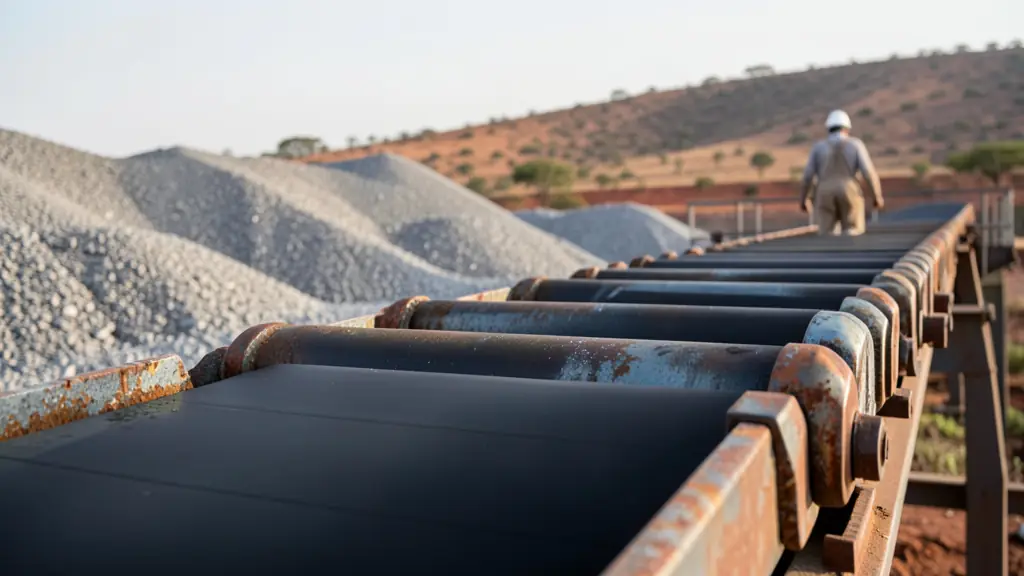
Worn bearings and seized shells are the commonest cause of belt damage and unplanned stops, so conveyor rollers are worth specifying properly. ConveyorBelting.co.za is a free quote-request service. Tell us the belt width, shaft size and duty, and we pass your request to independent suppliers who quote you directly. We do not sell rollers ourselves, and there is no charge or obligation. Whether you need a few conveyor belt rollers to replace failures or a full order for a new line, you can compare quotes from several suppliers.
Types of conveyor rollers
A roller for conveyor belt duty is a steel tube or HDPE shell running on sealed bearings on a fixed shaft. The main types are:
- Carrying rollers under the loaded belt, often in troughed sets
- Return rollers, plain or rubber-disc, on the empty side
- Impact rollers with rubber rings at transfer points
- Self-cleaning spiral or disc rollers for sticky material
- Guide and training rollers at the belt edge
Each type suits a different position, so say where the roller will sit.
Sizes, bearings and seals
Common shell diameters are 89, 102, 127, 152 and 178 mm. The roller face length follows the belt width, such as 600, 900 or 1200 mm belts. Heavy mining belts often need larger shells to lower roller speed and extend bearing life. Check the shaft diameter and the bracket or slot type before ordering, because the roller must drop into your existing frame.
Bearing and seal design decides how long a roller lasts. Labyrinth seals keep out dust and water, and good grease retention matters in wet or abrasive duty. Rollers should be tested for run-out, free turning and low rotational resistance. Rollers made to SANS 1313 or CEMA classes give a recognised basis for comparison.
Conveyor rollers for sale: what to compare
When you compare conveyor rollers for sale, look past the unit price. Compare the following:
- Shell wall thickness and straightness
- Bearing make, sealing and expected life
- Shaft finish and end machining
- Corrosion protection for coastal or wet sites
- Lead time and local stock of spares
A cheap roller that fails early costs more in downtime and belt damage than a better one.
Maintenance and replacement
Walk the conveyor and listen for noisy or seized rollers, and look for worn shells that can cut the belt. Replace failed rollers promptly, because a seized one wears flat and can slice the belt cover. Isolate and lock out the drive before any work.
Keep a stock of the most common sizes on site, and record roller positions so that repeat failures in one spot point to a cause such as misalignment, spillage build-up or poor sealing.
Comparing conveyor rollers quotes
Prices change with rubber and steel costs, the exchange rate and stock levels. When quotes arrive, check:
- Exact specification: width, carcass and strength, cover grade and thickness, or the part number, size and standard.
- Quantity and units: per metre, per roll, per item or per set, and any minimum order or cutting charge.
- Lead time: ex stock, or imported or made to order, and how long that takes.
- Delivery and VAT: transport to site, offloading of heavy rolls, whether VAT is included and how long the price holds.
What to include in your request
- Belt width and roller face length
- Shell diameter and shaft diameter
- Roller type and position on the conveyor
- Quantity and delivery location
- Material carried and site conditions
Frequently asked questions
Do you sell conveyor rollers?
What information do I need for a quote?
How do I know when to replace a roller?
Are steel or HDPE rollers better?
Conveyor Rollers by province
- Conveyor Rollers Gauteng
- Conveyor Rollers Mpumalanga
- Conveyor Rollers North West
- Conveyor Rollers Limpopo
- Conveyor Rollers Northern Cape
- Conveyor Rollers Free State
- Conveyor Rollers KwaZulu-Natal
- Conveyor Rollers Eastern Cape
- Conveyor Rollers Western Cape
Conveyor Rollers by city and town
- Conveyor Rollers in Johannesburg
- Conveyor Rollers in Pretoria
- Conveyor Rollers in Germiston
- Conveyor Rollers in Boksburg
- Conveyor Rollers in Benoni
- Conveyor Rollers in Kempton Park
- Conveyor Rollers in Springs
- Conveyor Rollers in Vanderbijlpark
- Conveyor Rollers in Vereeniging
- Conveyor Rollers in Carletonville
- Conveyor Rollers in Krugersdorp
- Conveyor Rollers in eMalahleni (Witbank)
- Conveyor Rollers in Middelburg
- Conveyor Rollers in Secunda
- Conveyor Rollers in Ermelo
- Conveyor Rollers in Kriel
- Conveyor Rollers in Mbombela (Nelspruit)
- Conveyor Rollers in Lydenburg
- Conveyor Rollers in Rustenburg
- Conveyor Rollers in Brits
- Conveyor Rollers in Klerksdorp
- Conveyor Rollers in Potchefstroom
- Conveyor Rollers in Polokwane
- Conveyor Rollers in Lephalale
- Conveyor Rollers in Burgersfort
- Conveyor Rollers in Phalaborwa
- Conveyor Rollers in Mokopane
- Conveyor Rollers in Kimberley
- Conveyor Rollers in Kathu
- Conveyor Rollers in Postmasburg
- Conveyor Rollers in Upington
- Conveyor Rollers in Springbok
- Conveyor Rollers in Bloemfontein
- Conveyor Rollers in Welkom
- Conveyor Rollers in Sasolburg
- Conveyor Rollers in Kroonstad
- Conveyor Rollers in Durban
- Conveyor Rollers in Pinetown
- Conveyor Rollers in Pietermaritzburg
- Conveyor Rollers in Richards Bay
- Conveyor Rollers in Newcastle
- Conveyor Rollers in Empangeni
- Conveyor Rollers in Gqeberha (Port Elizabeth)
- Conveyor Rollers in Kariega (Uitenhage)
- Conveyor Rollers in East London
- Conveyor Rollers in Cape Town
- Conveyor Rollers in Bellville
- Conveyor Rollers in Saldanha
- Conveyor Rollers in George
- Conveyor Rollers in Worcester