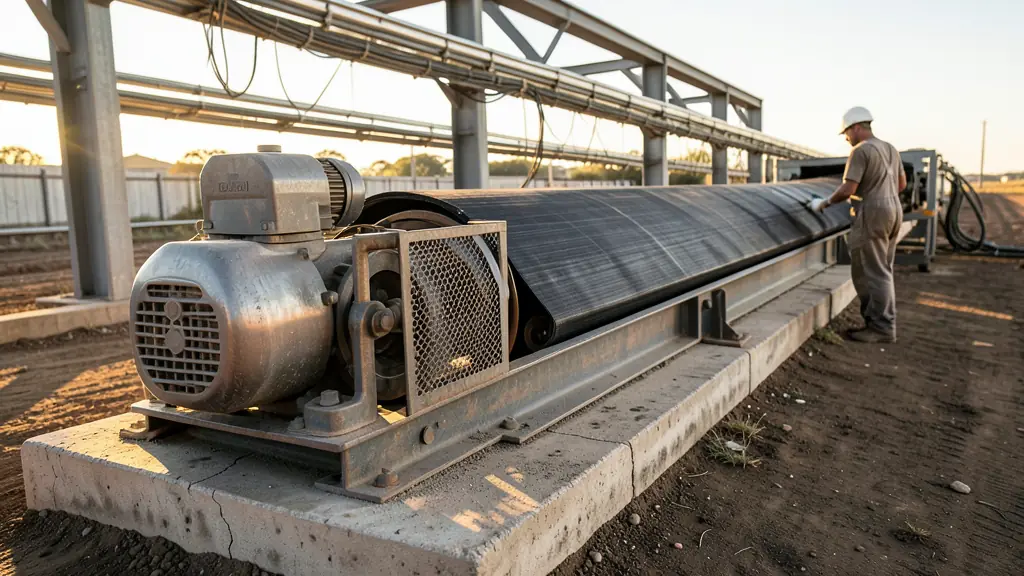
A conveyor belt motor and its gearbox turn the drive pulley that moves the belt. Choosing them well affects belt life, energy use and starting loads. This page covers the main drive options for belt conveyors. ConveyorBelting.co.za is a free quote-request service, not a supplier. Describe your conveyor, belt width, length, lift and duty, and we pass your request to independent suppliers of conveyor drive units, motors and gearboxes, who quote you directly and without obligation.
What a conveyor drive includes
A typical drive has several parts:
- Electric motor: usually a squirrel-cage induction motor
- Gearbox: a helical or bevel-helical reducer that cuts speed and raises torque
- Coupling: a fluid coupling or flexible coupling between motor and gearbox
- Drive pulley: a lagged drum that grips the belt
- Brake or backstop: holds an inclined belt from running back
Small conveyor belt with motor units may use a drum motor, where motor and gearbox sit inside the pulley.
Sizing motor power and torque
Motor power depends on belt width and speed, the length and lift, the mass of material carried, idler friction and the number of cleaners and skirts. Add an allowance for starting. A drive that is too small stalls under load. One that is too large wastes energy and may overstress the belt at start-up. A supplier will calculate the required power from your belt data, and you should keep a margin for future throughput.
Starting methods: VSD, soft starter and fluid coupling
A direct-on-line start can shock a long belt. Three options soften it:
- VSD: a variable speed drive controls acceleration and belt speed, and can save energy on part loads
- Soft starter: ramps motor voltage for a gentler start
- Fluid coupling: slips smoothly during start-up and limits peak torque
Long overland and loaded inclined belts often use a VSD or fluid coupling, with several motors sharing the load. Ask your supplier to check the belt tension during start-up and stopping, as well as at full speed, because those moments often set the belt rating.
Maintenance and spares
Check gearbox oil level and condition, motor bearing temperature, coupling alignment and guard condition on a routine. Vibration and thermal checks catch faults early. Keep critical spares, such as a motor or gearbox, on hand if a failure would halt production. Always lock out the drive before inspection or repair. Record oil changes, load readings and alignment checks, so that a trend in temperature or vibration can be spotted before a breakdown stops the belt.
Comparing conveyor drives and motors quotes
Prices change with rubber and steel costs, the exchange rate and stock levels. When quotes arrive, check:
- Exact specification: width, carcass and strength, cover grade and thickness, or the part number, size and standard.
- Quantity and units: per metre, per roll, per item or per set, and any minimum order or cutting charge.
- Lead time: ex stock, or imported or made to order, and how long that takes.
- Delivery and VAT: transport to site, offloading of heavy rolls, whether VAT is included and how long the price holds.
What to include in your request
- Belt width, speed, length and lift
- Material, tonnes per hour and starting conditions
- Drive pulley diameter and mounting arrangement
- Power supply, VSD or soft starter preference
- Site address and delivery or installation needs
Frequently asked questions
Do you sell conveyor motors and gearboxes?
What information does a supplier need to size a drive?
When should I choose a VSD over a fluid coupling?
Can an existing drive be upgraded?
Conveyor Drives and Motors by province
- Conveyor Drives and Motors Gauteng
- Conveyor Drives and Motors Mpumalanga
- Conveyor Drives and Motors North West
- Conveyor Drives and Motors Limpopo
- Conveyor Drives and Motors Northern Cape
- Conveyor Drives and Motors Free State
- Conveyor Drives and Motors KwaZulu-Natal
- Conveyor Drives and Motors Eastern Cape
- Conveyor Drives and Motors Western Cape
Conveyor Drives and Motors by city and town
- Conveyor Drives and Motors in Johannesburg
- Conveyor Drives and Motors in Pretoria
- Conveyor Drives and Motors in Germiston
- Conveyor Drives and Motors in Boksburg
- Conveyor Drives and Motors in Benoni
- Conveyor Drives and Motors in Kempton Park
- Conveyor Drives and Motors in Springs
- Conveyor Drives and Motors in Vanderbijlpark
- Conveyor Drives and Motors in Vereeniging
- Conveyor Drives and Motors in Carletonville
- Conveyor Drives and Motors in Krugersdorp
- Conveyor Drives and Motors in eMalahleni (Witbank)
- Conveyor Drives and Motors in Middelburg
- Conveyor Drives and Motors in Secunda
- Conveyor Drives and Motors in Ermelo
- Conveyor Drives and Motors in Kriel
- Conveyor Drives and Motors in Mbombela (Nelspruit)
- Conveyor Drives and Motors in Lydenburg
- Conveyor Drives and Motors in Rustenburg
- Conveyor Drives and Motors in Brits
- Conveyor Drives and Motors in Klerksdorp
- Conveyor Drives and Motors in Potchefstroom
- Conveyor Drives and Motors in Polokwane
- Conveyor Drives and Motors in Lephalale
- Conveyor Drives and Motors in Burgersfort
- Conveyor Drives and Motors in Phalaborwa
- Conveyor Drives and Motors in Mokopane
- Conveyor Drives and Motors in Kimberley
- Conveyor Drives and Motors in Kathu
- Conveyor Drives and Motors in Postmasburg
- Conveyor Drives and Motors in Upington
- Conveyor Drives and Motors in Springbok
- Conveyor Drives and Motors in Bloemfontein
- Conveyor Drives and Motors in Welkom
- Conveyor Drives and Motors in Sasolburg
- Conveyor Drives and Motors in Kroonstad
- Conveyor Drives and Motors in Durban
- Conveyor Drives and Motors in Pinetown
- Conveyor Drives and Motors in Pietermaritzburg
- Conveyor Drives and Motors in Richards Bay
- Conveyor Drives and Motors in Newcastle
- Conveyor Drives and Motors in Empangeni
- Conveyor Drives and Motors in Gqeberha (Port Elizabeth)
- Conveyor Drives and Motors in Kariega (Uitenhage)
- Conveyor Drives and Motors in East London
- Conveyor Drives and Motors in Cape Town
- Conveyor Drives and Motors in Bellville
- Conveyor Drives and Motors in Saldanha
- Conveyor Drives and Motors in George
- Conveyor Drives and Motors in Worcester