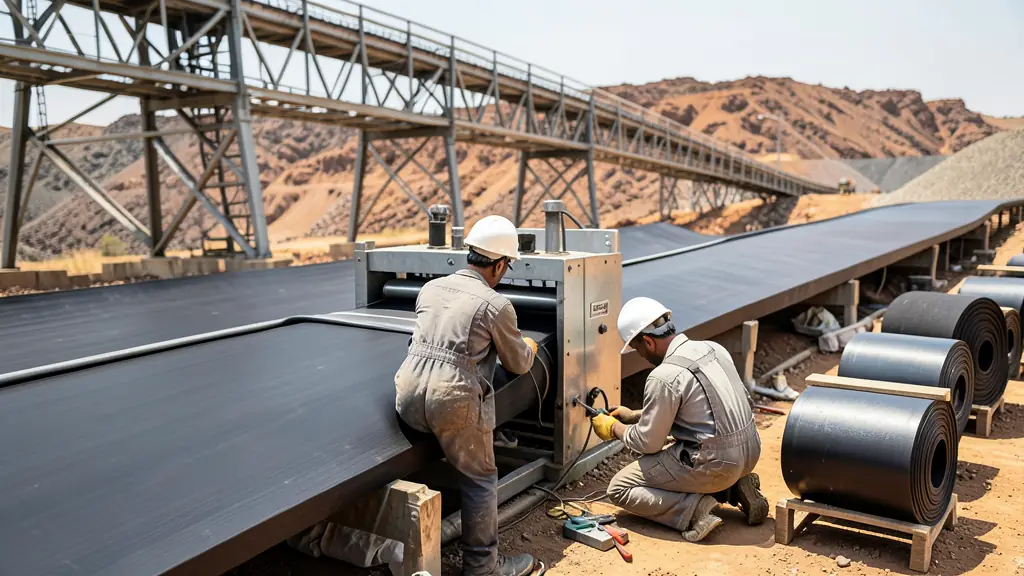
Conveyor belt splicing joins the two ends of a belt into an endless loop, or repairs a cut or damaged length. A good splice carries the full load. A poor one is the weak point that fails at the worst time. ConveyorBelting.co.za is a free quote-request service. Describe your belt and where it runs, and we pass your request to independent splicing contractors who quote directly. We don't carry out splicing ourselves. The request is free, and there is no obligation to accept any quote.
Types of belt splicing
The right belt splicing method depends on the belt, the duty and the downtime allowed:
- Hot vulcanising: heat and pressure bond the plies or cords into a strong, smooth joint
- Cold splicing: bonding with cold-cure adhesives, used where heat is not possible
- Mechanical splices: metal fasteners or clips, quick but less strong
- Finger splices: interlocking fingers on PVC and light belts
Steel-cord belts need hot vulcanising, as fasteners cannot grip the cords.
Hot vulcanising
Hot vulcanising gives the strongest joint for rubber belts. The crew skives the covers, steps or fingers the plies or cords, lays uncured rubber and cement, then cures it in a heated press under pressure. Steel-cord belts need a longer, carefully stepped splice. Quality depends on clean, dry conditions, accurate temperature and pressure, and the trained splicer's skill. Ask whether the contractor follows the belt maker's splice procedure. A well-made splice is usually the same strength as the belt, and a good crew checks it again after the first hours of running.
Cold splicing and mechanical joins
Cold splicing suits repairs where a press cannot be used, such as underground or in places with fire risk. It is faster, but usually slightly weaker than a hot splice. Mechanical fasteners join belts in minutes and suit temporary fixes or light belts, though they wear the pulley lagging and cleaner blades, and cannot be used on all belts. Choose by duty, not by speed alone. A mechanical join that was meant to be temporary often stays for months, so plan the permanent splice at the next planned shutdown.
Skills, training and safety
Splicing work needs trained people. Many contractors run a belt splicing course and offer conveyor belt training for in-house crews. Work must meet the Mine Health and Safety Act on mines and the OHS Act and Driven Machinery Regulations elsewhere: lock-out the conveyor, isolate power, secure the belt against movement and control hot work near flammable material. Ask for splicer qualifications, references and a method statement. Also ask about a warranty on the splice and about the contractor's response time for breakdowns, since a failed splice stops the whole conveyor.
Comparing quotes for conveyor belt splicing
The lowest rate is not always the cheapest job. When your quotes arrive, check:
- Scope: what is included, the method to be used and which materials and consumables the contractor supplies.
- Time on site: crew size, hours needed and whether they can work inside your shutdown window or at night.
- Safety and paperwork: site induction, medicals, risk assessments and lock-out procedures for mine or plant work.
- Guarantee: what the contractor guarantees, for how long, and the call-out terms if something fails.
What to include in your request
- Belt width, plies or ST rating, and cover thickness
- Textile or steel cord, and any special type such as fire-resistant
- Splice method wanted, or the purpose, such as repair or new join
- Site location, access and the shutdown window
- Whether materials are supplied or must be quoted
Frequently asked questions
Do you do belt splicing yourselves?
Which is better, hot or cold splicing?
How long does a splice take?
Can my own staff be trained to splice?
Conveyor Belt Splicing by province
- Conveyor Belt Splicing Gauteng
- Conveyor Belt Splicing Mpumalanga
- Conveyor Belt Splicing North West
- Conveyor Belt Splicing Limpopo
- Conveyor Belt Splicing Northern Cape
- Conveyor Belt Splicing Free State
- Conveyor Belt Splicing KwaZulu-Natal
- Conveyor Belt Splicing Eastern Cape
- Conveyor Belt Splicing Western Cape
Conveyor Belt Splicing by city and town
- Conveyor Belt Splicing in Johannesburg
- Conveyor Belt Splicing in Pretoria
- Conveyor Belt Splicing in Germiston
- Conveyor Belt Splicing in Boksburg
- Conveyor Belt Splicing in Benoni
- Conveyor Belt Splicing in Kempton Park
- Conveyor Belt Splicing in Springs
- Conveyor Belt Splicing in Vanderbijlpark
- Conveyor Belt Splicing in Vereeniging
- Conveyor Belt Splicing in Carletonville
- Conveyor Belt Splicing in Krugersdorp
- Conveyor Belt Splicing in eMalahleni (Witbank)
- Conveyor Belt Splicing in Middelburg
- Conveyor Belt Splicing in Secunda
- Conveyor Belt Splicing in Ermelo
- Conveyor Belt Splicing in Kriel
- Conveyor Belt Splicing in Mbombela (Nelspruit)
- Conveyor Belt Splicing in Lydenburg
- Conveyor Belt Splicing in Rustenburg
- Conveyor Belt Splicing in Brits
- Conveyor Belt Splicing in Klerksdorp
- Conveyor Belt Splicing in Potchefstroom
- Conveyor Belt Splicing in Polokwane
- Conveyor Belt Splicing in Lephalale
- Conveyor Belt Splicing in Burgersfort
- Conveyor Belt Splicing in Phalaborwa
- Conveyor Belt Splicing in Mokopane
- Conveyor Belt Splicing in Kimberley
- Conveyor Belt Splicing in Kathu
- Conveyor Belt Splicing in Postmasburg
- Conveyor Belt Splicing in Upington
- Conveyor Belt Splicing in Springbok
- Conveyor Belt Splicing in Bloemfontein
- Conveyor Belt Splicing in Welkom
- Conveyor Belt Splicing in Sasolburg
- Conveyor Belt Splicing in Kroonstad
- Conveyor Belt Splicing in Durban
- Conveyor Belt Splicing in Pinetown
- Conveyor Belt Splicing in Pietermaritzburg
- Conveyor Belt Splicing in Richards Bay
- Conveyor Belt Splicing in Newcastle
- Conveyor Belt Splicing in Empangeni
- Conveyor Belt Splicing in Gqeberha (Port Elizabeth)
- Conveyor Belt Splicing in Kariega (Uitenhage)
- Conveyor Belt Splicing in East London
- Conveyor Belt Splicing in Cape Town
- Conveyor Belt Splicing in Bellville
- Conveyor Belt Splicing in Saldanha
- Conveyor Belt Splicing in George
- Conveyor Belt Splicing in Worcester