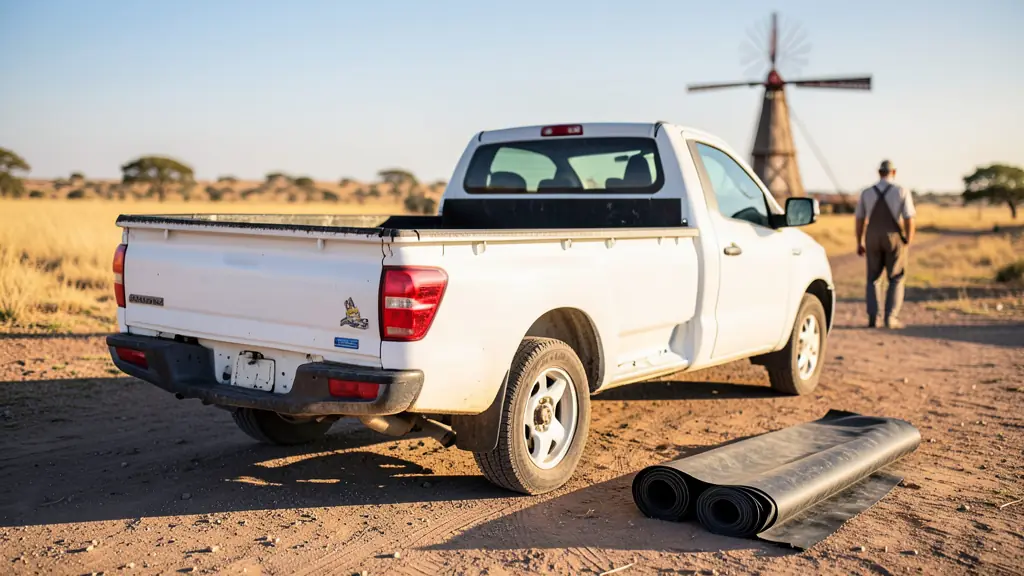
Conveyor belt mats for bakkies are one of the most practical uses for heavy rubber belting. A length of belt cut to size protects a load bin, covers a trailer floor, lines a cattle crush or makes a hard-wearing walkway. ConveyorBelting.co.za is a free quote-request service. Tell us what size and thickness you need and whether new offcuts or used belting will do. We pass your request to independent suppliers who quote you directly. We don't sell mats ourselves, and there is no obligation to accept a quote.
Where belt mats are used
Rubber belting is tough, flexible and grips well, which is why conveyor belt matting turns up in so many places outside a plant:
- Bakkie and truck load bins: protects the steel from bricks, poles and machinery
- Trailer and horsebox floors: non-slip and easy to hose down
- Stables, milking parlours and cattle crushes: comfortable, hygienic underfoot
- Walkways and ramps: grip in wet or muddy areas
- Wear liners: chute and hopper protection, and gate and door stops
On farms, a single length of belt often serves several jobs over its life. It starts in a bakkie, then moves to a stable floor or a muddy gateway when it wears.
New offcuts or used belting
Suppliers sell conveyor belt offcuts from new rolls, and used belting taken off plants when a belt is replaced. New offcuts have clean covers and known specifications. Used belting costs less and is often fine for floors and liners, but it may carry cuts, patches or uneven wear. Ask for photos, the thickness at several points and whether the belt ran oily or chemical material. For food areas, animals or drinking water, ask for clean material.
Choosing thickness and type
Most rubber belting for farms and bakkies is textile-reinforced, about 8 to 15 mm thick, and cut from belts of 450 to 1200 mm width. Thicker belting resists puncture better but is heavier to handle. Multi-ply belting with a smooth top cover suits load bins. A ribbed or patterned surface gives extra grip on ramps. Steel-cord belting is rarely used for mats, as it is hard to cut and can expose wire ends. If a supplier offers fire-resistant or oil-resistant belting offcuts, check that the compound suits the use, for example oil resistance for a workshop floor.
Cutting, fitting and safety
Measure the floor, then cut with a sharp hook blade or an angle grinder with a cutting disc. Cutting steady and straight gives cleaner edges. Wear gloves and eye protection, because rubber dust and wire strands can injure. Keep the mat flat, tuck edges under tie-down points and avoid loose corners. Heavy belting can weigh over 10 kg per metre of width, so check axle and payload limits. Fix a bakkie mat with rubber straps or a few countersunk bolts rather than loose ties. A mat that slides can hide a hole or rust in the bin, so lift and inspect it now and then.
Comparing conveyor belt mats quotes
Prices change with rubber and steel costs, the exchange rate and stock levels. When quotes arrive, check:
- Exact specification: width, carcass and strength, cover grade and thickness, or the part number, size and standard.
- Quantity and units: per metre, per roll, per item or per set, and any minimum order or cutting charge.
- Lead time: ex stock, or imported or made to order, and how long that takes.
- Delivery and VAT: transport to site, offloading of heavy rolls, whether VAT is included and how long the price holds.
What to include in your request
- Length and width needed, or the bin or floor size
- Preferred thickness and surface
- New offcuts or used belting
- What the mat will be used for, including animals or food areas
- Delivery address, or collection preference
Frequently asked questions
Do you sell conveyor belt mats?
What size and thickness should I ask for?
Is used belting safe for animals?
Can I get belting delivered to a farm?
Conveyor Belt Mats and Offcuts by province
- Conveyor Belt Mats and Offcuts Gauteng
- Conveyor Belt Mats and Offcuts Mpumalanga
- Conveyor Belt Mats and Offcuts North West
- Conveyor Belt Mats and Offcuts Limpopo
- Conveyor Belt Mats and Offcuts Northern Cape
- Conveyor Belt Mats and Offcuts Free State
- Conveyor Belt Mats and Offcuts KwaZulu-Natal
- Conveyor Belt Mats and Offcuts Eastern Cape
- Conveyor Belt Mats and Offcuts Western Cape
Conveyor Belt Mats and Offcuts by city and town
- Conveyor Belt Mats and Offcuts in Johannesburg
- Conveyor Belt Mats and Offcuts in Pretoria
- Conveyor Belt Mats and Offcuts in Germiston
- Conveyor Belt Mats and Offcuts in Boksburg
- Conveyor Belt Mats and Offcuts in Benoni
- Conveyor Belt Mats and Offcuts in Kempton Park
- Conveyor Belt Mats and Offcuts in Springs
- Conveyor Belt Mats and Offcuts in Vanderbijlpark
- Conveyor Belt Mats and Offcuts in Vereeniging
- Conveyor Belt Mats and Offcuts in Carletonville
- Conveyor Belt Mats and Offcuts in Krugersdorp
- Conveyor Belt Mats and Offcuts in eMalahleni (Witbank)
- Conveyor Belt Mats and Offcuts in Middelburg
- Conveyor Belt Mats and Offcuts in Secunda
- Conveyor Belt Mats and Offcuts in Ermelo
- Conveyor Belt Mats and Offcuts in Kriel
- Conveyor Belt Mats and Offcuts in Mbombela (Nelspruit)
- Conveyor Belt Mats and Offcuts in Lydenburg
- Conveyor Belt Mats and Offcuts in Rustenburg
- Conveyor Belt Mats and Offcuts in Brits
- Conveyor Belt Mats and Offcuts in Klerksdorp
- Conveyor Belt Mats and Offcuts in Potchefstroom
- Conveyor Belt Mats and Offcuts in Polokwane
- Conveyor Belt Mats and Offcuts in Lephalale
- Conveyor Belt Mats and Offcuts in Burgersfort
- Conveyor Belt Mats and Offcuts in Phalaborwa
- Conveyor Belt Mats and Offcuts in Mokopane
- Conveyor Belt Mats and Offcuts in Kimberley
- Conveyor Belt Mats and Offcuts in Kathu
- Conveyor Belt Mats and Offcuts in Postmasburg
- Conveyor Belt Mats and Offcuts in Upington
- Conveyor Belt Mats and Offcuts in Springbok
- Conveyor Belt Mats and Offcuts in Bloemfontein
- Conveyor Belt Mats and Offcuts in Welkom
- Conveyor Belt Mats and Offcuts in Sasolburg
- Conveyor Belt Mats and Offcuts in Kroonstad
- Conveyor Belt Mats and Offcuts in Durban
- Conveyor Belt Mats and Offcuts in Pinetown
- Conveyor Belt Mats and Offcuts in Pietermaritzburg
- Conveyor Belt Mats and Offcuts in Richards Bay
- Conveyor Belt Mats and Offcuts in Newcastle
- Conveyor Belt Mats and Offcuts in Empangeni
- Conveyor Belt Mats and Offcuts in Gqeberha (Port Elizabeth)
- Conveyor Belt Mats and Offcuts in Kariega (Uitenhage)
- Conveyor Belt Mats and Offcuts in East London
- Conveyor Belt Mats and Offcuts in Cape Town
- Conveyor Belt Mats and Offcuts in Bellville
- Conveyor Belt Mats and Offcuts in Saldanha
- Conveyor Belt Mats and Offcuts in George
- Conveyor Belt Mats and Offcuts in Worcester